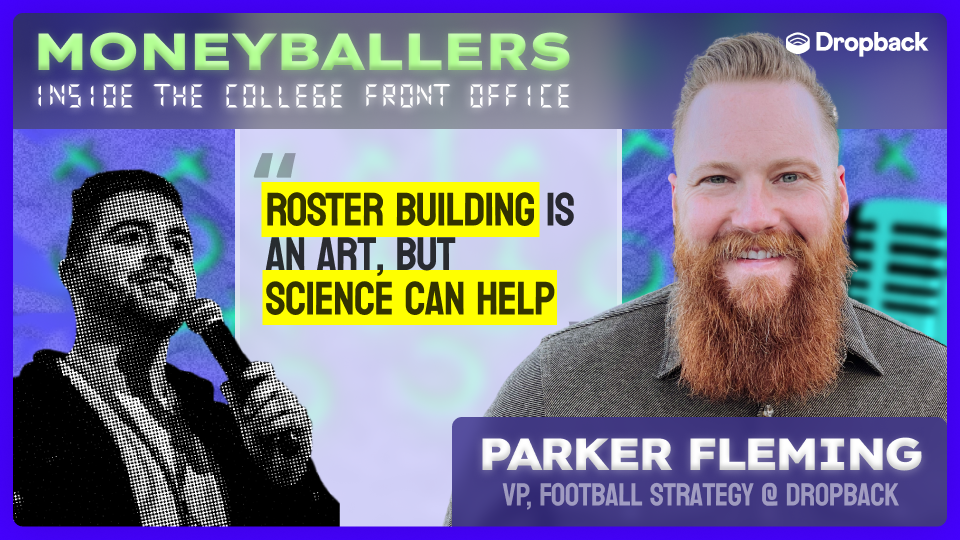



In this episode, Dropback welcomes Parker Fleming, our new VP of Football Strategy at Dropback. He discusses the importance of structured thinking, the balance between qualitative and quantitative analysis, and the challenges of integrating data into decision-making processes in college football. Parker emphasizes the need for continuous learning and experimentation in analytics, as well as the significance of effective communication to gain buy-in from coaches and front offices. Analytics is a journey, not a destination!
Our Takeaways
-
Structured thinking is crucial in analytics, not just the final numbers.
-
Learning by doing is essential for success in sports analytics.
-
Data should inform decisions, not replace human judgment.
-
The balance between qualitative and quantitative analysis is vital in roster construction.
-
Opportunity cost is a significant factor in roster building decisions.
-
Analytics can enhance traditional scouting methods, not replace them.
Chapters
- 02:57 Parker's Path to Sports Analytics
- 06:01 Learning and Experimentation in Analytics
- 09:03 The Role of Analytics in Decision Making
- 12:10 Balancing Qualitative and Quantitative Analysis
- 14:52 Overcoming Resistance to Data-Driven Decisions
- 17:54 The Importance of Communication in Analytics
Full Transcript
Luke (01:06) Parker Fleming, Dropback's new VP of football strategy. Dude, welcome to the team and welcome to the podcast. How's it going?
Parker Fleming (01:12) Thank you, I'm excited
It's been a crazy couple of days in a good way, getting on boarded and kind of seeing everything
guys are building and we're gonna build together and excited to chat a little bit this morning.
Luke (01:22) So much to talk about when it comes to roster construction and fusing data into those decisions. And I think it's perfect because that's the whole point of the Moneyballers podcast is we talk through people who are boots on the ground in these new evolving front offices in college sports. College football obviously is going to be the focus of this
you came into the journey of infusing analytics into better decision making from a very interesting past. Maybe that kind of walked me through from an education master's degree to an economics PhD
to now tweeting a bunch of cool stuff about analytics on Twitter, like walk me through kind of that journey.
Parker Fleming (01:50) I was a religion major undergrad, went to TCU and did economics as a minor. And I liked a joke that both econ and religion were talking about people respond to incentives, some worldly and some otherwise and learning about that. So was always interested in structured thinking around systems and understanding behavior and decision-making in that
and didn't really know what to do with it. Wasn't sure I wanted to be like a full-time academic. So I went and taught middle school English for two years out of college. and just as kind of a, let's do this was a great camp counselor in college and thought that would transfer. And it turns out there's a lot more paperwork and teaching than just hanging out with kids. So I was looking for what's next and did a master's while I did that. And that was cool to learn a lot about like the, again, the theory of thinking and, and how do you approach different styles of learning. Cause I think that some of that stuff has been really useful
in talking to coaches and then working with people to understand, if I have a great analytics idea, if I can't communicate it, it doesn't matter.
But knew that I was an interested person, had questions about the world and wanted a toolkit that was a little more formal than my liberal arts undergrad. So I kind of played dartboard and a map and found a master's program at the University of Montana that paid me to come get a master's. And I took seven math classes and four semesters to get the prereqs that I needed. And so, wanted that empirical toolkit, wanted to build that, was focused on issues of like religion and political economy. As I was taking those math classes,
they were boring, frankly. That's not a reflection on the teachers had some great teachers, but it was just dense and I needed a way to make it applied. So I started playing around from some football stuff was deeply influenced by Bill Connelly, Brian Fremont, in the football space and Aaron Schatz, a bunch of people who've done some good work and said, Hey, how can I think about this? So that turned into kind of moonlighting and doing some media coverage for TCU and then college football overall as football outsiders. And then as I was finishing up the PhD, my options were kind of go be a professor
somewhere random or try to make this sports thing full time and give it a go. And so I was able to take that toolkit of empirical methods and link that with, I think, a lot of curiosity and a lot of really cool ways to think about things with my economics background and join that into how do we ask and answer interesting questions about sports.
Luke (03:54) Maybe walk me through a little bit you're of course, formally educated but really for the most part, you kind of were self-chot.
Learn how to write code yourself. You took your passion of football and applied it to the knowledge that you had. And now here you are, VP of football strategy. Walk me through folks who like want to get into analytics. Do you have to become a PhD? What were the things that you did? Maybe yourself on the side, self-taught that was the most impactful. know you have a bunch of books on your wall, so I'm sure reading is one of the answers, but like walk me through kind of that ramp up.
Parker Fleming (04:22) Yeah, so if you want to get into sports analytics and you're considering a PhD definitely do sports related research, which is something I didn't do. I kind of did all on the side and my dissertation was about Billy Graham and political revivals and how that affected voting. And so I learned, I think my formal education was less like coding and data science and analytics and much more, you know, how to learn and how to learn those things and how to make sure we're approaching that the right way. So I think learning by doing is one of the best ways to do
I think if you sit in a classroom and you learn all the methods and you don't do a single project, you're not going to be at top of the industry. So I do think there is some credentialing. Definitely go get an education. Don't drop out of high school and do a boot camp and try to get in. But I think the biggest thing is, if you're doing sports analytics, you're interested in sports. So what are you interested in? What questions are you trying to ask and answer? And then learn the tools
to answer those questions. I think people sit down and say, I'm going to master Bayesian optimization. And that's great. It's useful to have in your toolkit. But I think you should start by saying, Hey, I want to know which minor league baseball prospect has the best probability of making the majors. And then you think, okay, how do I do that? Well, I need some priors, need
numbers on that. And then you go learn Bayesian optimization in that framework. So there's a wealth of tools and resources online where I think owning the learning processes is really, really key. And I don't want to speak about the learning
process and past tense. I'm learning and trying new methods every day and then and seeing how I can build my toolkit to better ask the questions that kind of present in day-to-day analytics work.
Luke (05:45) I like that and I like how somebody that's seemingly, I mean, you are an expert, but also seemingly online as an expert, that's like, man, I could never get to that level. But kind of to what you're saying is you have to start somewhere.
if you really want to grapple and leverage analytics,
have to take ownership and try new things. And even you who's been in the industry for a while now, like you're trying new things, you're trying new methods, you're trying new models. So I think that's like really motivating for maybe the listeners to understand is that if you want to infuse analytics into your decision making, whether it be your end of front office or
or you're a hobbyist, there's somewhere to start. You don't have to start by dropping out of your career and getting a PhD. You just have to start by doing stuff and experimenting and having your topics be focused on sports, like you're saying.
Parker Fleming (06:24) And the great lie of like Moneyball and the Michael Lewis and the Brad Pitt movie is that like one, they had a great pitching staff. So the OBP stuff was a little overblown, but I think it comes across and people, know, the media and observer sees it as like, ⁓ baseball found this one weird trick and that changed everything. And that's not totally untrue, but the one weird trick wasn't, hey, use OBP to evaluate players. It was, hey, we can systematically evaluate players in a way that we can compare to the market and we can make decisions. OBP is priced into the market. Like baseball teams have continued to
push and continue to innovate. So, the fundamental principle of we need to use data to inform our decisions to find surplus value has not changed.
end of analytics. Like the journey is the destination. It's about using data to make decisions. It's not about the answers that you get from the data.
Luke (07:09) Yeah, that actually bleeds great into the first topic I want to discuss. You wrote an awesome stuff stack recently where you kind of touched on what you just said. The quote from the article is that the point of analytics and models isn't always decimal point precision, but rather structured thinking. Expand on that. the goal is not to build the perfect all in one. It's that the journey of creating the all in one helps refine the process.
Parker Fleming (07:30) Yeah, I'll answer that with an example. I was working with a power four program back in 2019 and doing some questions, some one-off projects for them. And they were really fixated on fourth downs and, edge case scenarios for fourth downs. How do we think about this? And I think they really wanted me to say like, Oh, my model says X, Y, and Z. And this is how we, you know, this is the definitive decision that you should make. And what I actually did was, you know, flip it on its head and say, great, what do you think the probability you're going to convert a two point conversion is? What do think?
the
probability you're going to win in overtime is? What do you think the probability is you get a stop? Now we can use analytics, take those inputs and just say, okay, on your own terms, it's a plus decision to go.
you think by the associated probabilities. Now, if you want to change those probabilities and make a different different decision, that's fine. But the benefit of analytics was not, Hey, I've got a fourth down, you know, when probability model that is accurate to the seventh decimal place and blows everyone away. That's very useful and you should have that and you should work on that. But the real analytical thinking there was, okay, how do we input that information into a system and then examine our decision making process based on it and compared to a baseline and then understand on our own terms, what does the math say about what we're doing?
I think the key there, like the big benefit of analytics is not, Hey, I slapped an XG boost on some numbers and got a good mean absolute error, a good R square or log loss or whatever. it's more so like when you build that XG boost, what you're forced to do is think, okay, what is my target variable? What do I think is influential there? Are any of those variables related? Is there a time component? Does this change over time? Do I need to account for that as well? And that's your structured thinking that you're doing. again, the journey is kind of the destination there.
Like the analytics is not, I pressed hit, I pressed run, I got a cup of coffee and came back and got a good number. The analytics is what needs to go into a good model.
Luke (09:08) maybe walk through a little bit. I totally agree. lot of scary words you said, maybe somebody who doesn't know analytics and data science. Do you need to hire and bring in an expensive expert to take advantage of data to make better decisions?
Parker Fleming (09:22) There are cases where, you know, outside data with consultant could help you if you have a very specific question. You're like, Hey, I don't have the technical capacity to do that. I think a lot of what we're seeing is, at both like the pro and college level is, Hey, this guy did a project that was really cool. I'm going to bring him in. And there's this period at the beginning of, okay, what do I do with him? Like, how do I structure it approach this? Like, what do I do? Even, you know, some of the services that are out there that say, you know, we have this proprietary model. This is, this is informing your decisions, like use our data. There's great
value in a lot of those. I think the key is like having a plan for what questions do we need to measure? What do we need to answer to understand that? And without that good sense, you're not going to get the full benefit and you're probably going to be doing a lot of stuff that doesn't really impact your day to day. The flip side of that is I think there's a lot of juice to squeeze with very basic numbers. So I could tell you right now that I don't think, you know, pass total passing yards is a super great signal of player quality, right? But I think there's ways where
comparing players based on passing yards is better than just saying, yeah, I like this guy.
He's got a good GPA. He's got a pretty girlfriend. We think he's got confidence or whatever they say in moneyball. starting to squeeze juice from the basic numbers is a great first step and kind of hitting your limitations on what you can do with what you have. And then that might be the time to say, okay, I've run this as far as possible. How do I go further? What tools do I not have? Similar to the learning process, right? Don't go learn the fanciest method just to know the method. Like start with the identity of what do need this for and then learn what you need to do or bring somebody in to do
it.
Luke (10:50) Yeah, that's a great highlight.
goes to show again that infusing data and analytics into your decisions, you don't have to be a PhD. You don't have to know what XGBoost means. It just starts with something like pick a couple of metrics into your point during the journey of exploring the process of let's try this one or two data points to infuse our decision quickly after three months of honing in on that process that becomes five or 10 or 20. And then all of sudden you have this really rigorous process to think about things. And, we talk to GMs and front offices daily, like that
process has become
absolutely invaluable in this world of finite resources, whether that be finite roster spots that you can fill, finite budget that you're given from your administration. And so that kind of maybe leads me to the second quote that's from one of your articles that I like is that roster building is an art, but science can help. Is there any
specific learnings that you've taken over, NIL being a thing for the last five years, but really the salary cap era rev share being here for now just one portal off season,
how teams can more effectively balance the qualitative side of scouting but also now the quantitative side of making decisions with some of these data and analytics infused into their process.
Parker Fleming (11:55) One, I'm glad you pulled that out. I thought that was a banger, a pull quote from that article.
Again, the qualitative stuff matters. Character and makeup matters so much and it's kind of weighing those in both hands. The big thing for college programs over the last couple years is opportunity cost. I think that's what we're seeing some of the best programs face. And whereas in the Saban Era, Pre-Portal, Pre-NIL, you could stack 44 blue chip recruits very easily on your roster and always have a next man up who is going to be the prototypical player exactly who you want. And now that talent's diverse, you're starting to think, okay, what's actually important on my
roster and by getting this guy, not only the money that we have to commit to him, but the time and energy to do the recruiting process, to eval, to call his high school coaches, all of that. What else could we be getting with this and weighing that kind of opportunity cost? And that's where the qualitative and the quantitative really, really meet. Because it's never going to be, especially in a low sample size sport like college, where you have raw prospects coming in, you have insane variability in the quality of prospect. It's never going to be, hey, this recruiting
model says X, so I'm going to go get it. But it doesn't mean you shouldn't have a recruiting model that can help you differentiate among players. There's going to be the qualitative side. I think where you can kind of meet analytics and qualitative
analysis really, really nicely is starting to structure and formalize that. So coaches that are scouting and coaches that are doing character grades, keep those over time. Look at trends, start to think about how do how does the average player change? Do do we need to project guys of what they are and what they will be? How do we move those? So there's a lot of analytical thinking that you can do on top of the stuff that's happening in buildings everywhere. That's only going to enhance those processes. It's not saying, hey, listen to the nerds and do things differently. It's saying you've got some really good ideas. If we structured this,
in a way that helped you think about opportunity cost and the time horizon, then we can really multiply your effects and really take you to the next level and start getting you more value for the analysis that you're doing.
Luke (13:45) Yeah, data and analytics should scale your processes, not replace them. The whole goal is not the nerds take your job by building this really cool AI model, or I'm going to pay for this expensive vendor to tell me who the best players are. it's important that the eyeballs still matter. Qualitative still matters. Like that should be the decision. But to your point, data is one vote of many votes at the table and most of the votes are human. But if you have a great process to think about it qualitatively with data with a great model, with a great process, whatever it might be, like it can help inform
and make the human decisions better.
Parker Fleming (14:15) Yep, absolutely. And that's the key there is like analytics is not replacing anyone. It is all saying, hey, it's much more competitive now. We're answering new questions. This is a really good way to do some structured thinking about what you're already doing to keep you competitive.
Luke (14:29) Maybe on that vein, I know that a lot of times it's easy to say that data is just one voice at the table, but it's daunting. folks who build their careers off of just using my eyeballs to grind film and find the diamonds in the rough. Like that does still matter, but even infusing a little bit of data into that process could be scary. Like, what do you think are the hardest parts about getting coaches or front offices who maybe have data, but maybe aren't leveraging data to inform decisions? Like what's the hardest
part about the translation process and actually adopting this to be a point where data is a vote at the table.
Parker Fleming (15:03) I mean, I've had a Power 4 football coach tell me on a call that I was a nerd and he wasn't following anything I was doing. there's some level of communication, there's kind of two things. And you see this a little more in college, I think, than even the NFL, but it's prevalent with both on kind of the scouting side is a little bit of gatekeeping. And I don't mean that as negatively as it might sound, but the idea of like...
Hey man, I drove to random D two colleges all over the West for 10 years and stayed in hotels and built up and learned football from the best. And I'm here. Why am going to listen to you? And so that is the onus is on the analytics people. And I think even when, you know, people are shouting about the fourth down discourse on Twitter, which convincing the public is probably not a noble aim for analytics, but there is some responsibility there to say, like, if, people don't understand it you're talking about it, you have to communicate it to some degree. if you want buy-in. I think there's kind of a combination of the
gatekeeping
the responsibility to communicate it and figure out a way to do it. I also think there is a tendency to drill down on one specific thing and so I've been in calls where you know a coach disagreed with an output.
And my philosophy there is like, great, that's information for me. I can go make this better. but initially if a coach sees something where, know, it's out of order, they're going to say, well, it's wrong. that doesn't give me the information. so communicating to them, Hey, I'm not saying this is my opinion. This is the right way to do it. I'm saying, this is the way we're thinking about it. And this is a discussion point for us to continue to move on. And we're going to move guys up and down the list based on the numbers and reorder and do all that. And I've had some great success with some NFL scouts who are really data curious and honestly,
Some of the guys who are most data averse were using data already. They were just using it inconsistently and it was kind of weird. And so once we unified their approaches and said, Hey, we're not coming for your jobs. we want to work with you. I think there was a lot of buy in there as they understood, this is kind of already what I'm doing. I'm still a subject matter expert in this and the nerd is never going to know ball like I do. And so we can work together to, you know, direct him and figure out where to go with that.
Piggybacking on my earlier advice about how to
get into analytics, I think you've got to watch the game and you've got to know ball. Part of that is innovation. Like you read widely when you're trying to do a project to find what other people have done to spur innovation. The same way I've come up with some really cool projects, just watching a team and a certain player frustrated me. And I said, you know what? I'm going to do something about this. And so I think that's really important as well. Also, when you're talking to coaches, you're going to go a lot farther in any sport saying like, Hey man, the left tackle that's going to start for you this fall. I know he started two games last week or last year.
dude, I think he's got long arms. I think he could be really, you know, a stable player. Well, I use that. I know that knowledge because my NFL draft model or whatever has that information and I'm very familiar with it, but I put it in terms where I could start to talk to the coach and kind of meet him on his own terms and say, hey, I'm getting similar conclusions on some things to you from a very different approach. Let's see where the value is.
Luke (17:47) Yeah, no, that's a great point. Maybe the wrap up the episode, you are infamous, famous, I don't know, for tweeting your thoughts a lot, especially some fun graphs. Like what's your like most memorable Twitter moment from your massive following that you have.
Parker Fleming (18:00) it's crazy. Like people have notifications for my tweets. So there are like multiple people who the second I tweet something, gets likes on it. And that terrifies me that I have like a direct window to people's pockets and kind of horrifying. But Twitter's been fun. It started as kind of an outlet. Like I was texting in the group chat and...
was putting all this crazy stuff and my friend Jamie, who does a great job covering TCU on the media side was like you should just write a blog on this. Like you need to put, you need to put some of that out there. So it's been really fun. It's opened a lot of doors. There was a couple of seasons where Gary Patterson, the head coach of TCU and I had a really fun relationship, arguing, agreeing, talking about stuff and working through. and that's always fun to do. There's been some great stuff. I'm kind of mad right now that like the thing that blows up the most is an intentionally kind of dumb graph.
with this, did we really get beat that bad? And you'd think that like the grammatical error in the title would tell everybody how to treat it in terms of seriousness, but it's not a non-useful thing. And I think it's actually a nice kind of broad brush to look back and say, Hey, net success rate, just moving the ball, you know, how well did that do? But that's like Monday morning, reliably, if I need a dopamine hit of, you know, interaction or validation, I just, I just ship it and, and, and put that out there, but it's fun. I've met people across the country, across the world who
Luke (19:06) Hit the tweet.
Parker Fleming (19:11) interest in analytics, I've been able to talk to coaches and find stories of players and new rooting interests just because I've talked to this guy and I know what the team's thinking about him and I wanted to succeed. And so it's been, it's been really, really fun, even as it has been, you know, stressful and probably I'm on it too much in general. But I think it's a great place to put public stuff out there. And some of the best moments I've had on Twitter is I've done something, realized there was a shortcoming because some of the people in my network just said, Hey, I think, I
this is backwards or whatever and I've been able to improve it. So it's like a living portfolio where I can improve and iterate as well and that's been really fun.
Luke (19:45) Yeah, I think it's a cool reflection, personal brand that you have.
compared to what your role now is at Dropback as the VP of football strategy where nothing's going to change. Like you're not here to be the guy where we're going to take all your thoughts you put on Twitter and put it behind a paywall. Like that's not how we operate. Like it's going be really cool that you get to do your thing, keep your journey publicly, work publicly with teams to show the latest and greatest thoughts on analytics and how to infuse that into roster construction. So I'm excited for you to keep doing your thing. And just so happens now you got the Dropback badge next to your name. So Parker, this was an awesome episode and really excited.
for our future work together. ⁓
Parker Fleming (20:20) Yeah,
absolutely, man. Thanks for having me and excited to keep building and keep growing.
Luke (20:25) Thanks.