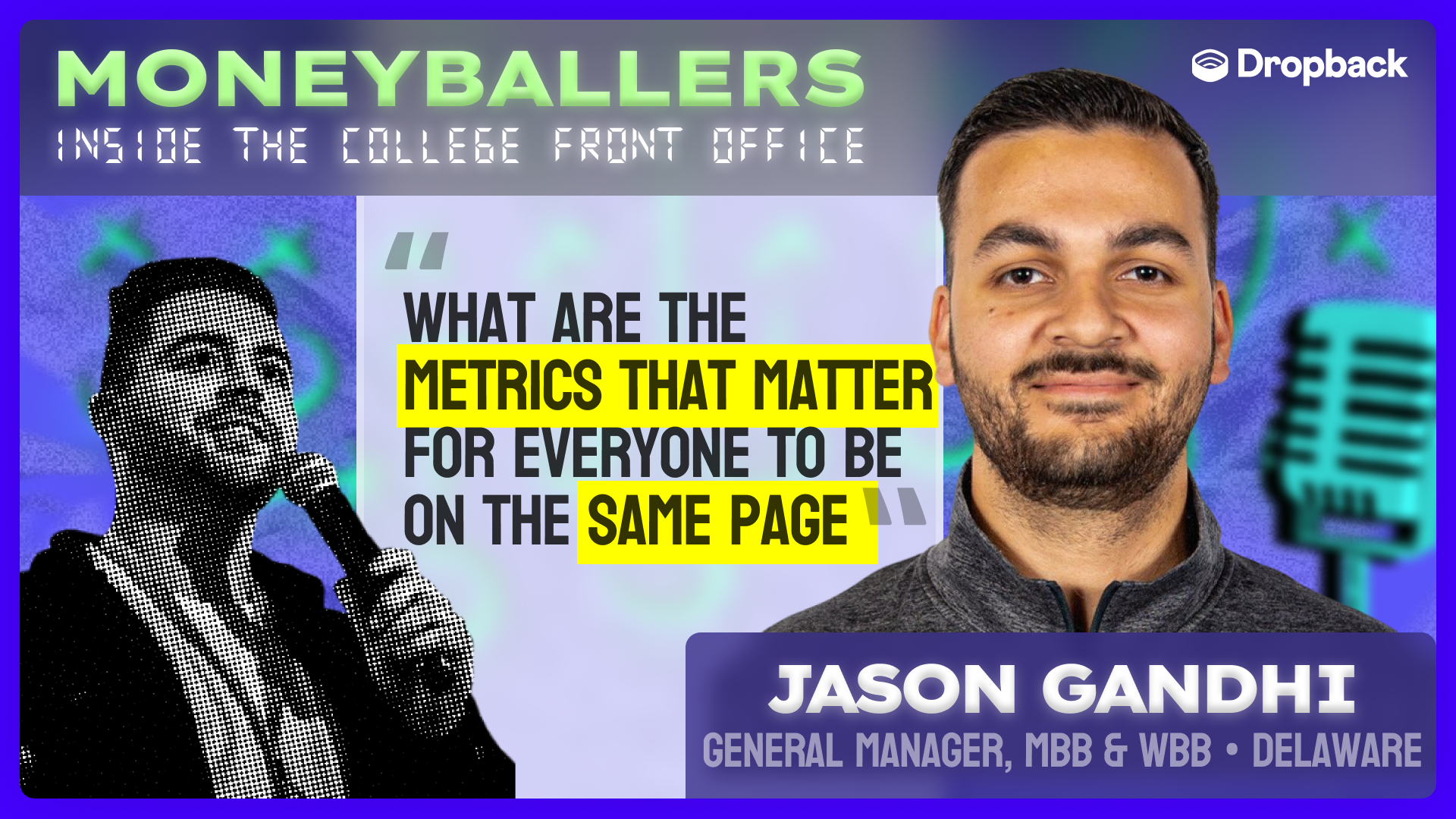


We've made it to Episode 10! In this fireside, Jason Gandhi — the General Manager of men's and women's basketball at Delaware — shares his unique journey. From manager at Indiana to overseeing their NIL initiatives, and now holding the prestigious GM title at an emerging program. He emphasizes the importance of collaboration between coaching and management, the challenges of roster management, and the strategic approach needed for recruitment, especially within non-P4 budget constraints.
Our Takeaways:
- Collaboration between coaching staff and front offices (administration, management, etc.) is crucial for success.
- Roster management involves not just recruitment but also athlete retention — especially for non-P4 programs.
- Budget constraints can lead to more strategic and effective recruitment.
- Navigating the different dynamics of men's and women's basketball is uniquely challenging for a dual-sport GM.
- Investing in a GM role for non-football sports can signal a commitment to program development.
- The future of college basketball will see more GMs as programs recognize their value.
Chapters:
- 00:00 Journey into College Basketball Management
- 03:09 Transitioning to General Manager Role
- 05:59 Collaboration Between Coaching and Management
- 09:02 Roster Management and Recruitment Strategies
- 12:03 Navigating Budget Constraints in Recruitment
- 14:47 The Role of General Managers in College Basketball
- 17:57 Future of General Managers in College Sports
Full Transcript
Luke Bogus (00:57) Jason Gandhi, GM of men's and women's basketball at Delaware. Dude, thanks for joining me. How's it going?
Jason Gandhi (01:02) Hey, it's good man, I'm really excited to be here, appreciate the time, excited to get into it.
Luke Bogus (01:05) Yeah, me too. ⁓ You're pretty fresh into the role. I think you started back in May, but you are not fresh in the world of NIL and actually working with basketball teams. It goes all the way back to Indiana where you with part of the team, but also you were strategic initiatives and NIL oversight there. So walk me through like your whole history in the space where GMs are kind of this new buzzy thing, but you've kind of been in the space for a while and you've also been in the space even pre-NIL. So walk me through kind of what was your job like pre-NIL.
Obviously you made the shift during the NIL era and now kind of in the rev share era, you're as a GM. It's like walking through a journey.
Jason Gandhi (01:39) So I've had a unique path. I've said all the time, I think everybody that's been successful in the athletic sports industry, like they've got unique paths. And I think I'm another one of those examples. I was really fortunate to be an Indiana basketball manager. it's a fraternity that's, think one of the best fraternities in the world because it's got unbelievable names and a family Unlike any other. I was really fortunate to be mentored in a really special way with the people I was working with. And I got really just to understand how college basketball worked at a level that I was really just fortunate to have.
I mean, getting to see recruiting, ops, video, and then just the value of relationships. I think as a manager, I was just really, really fortunate. And because the success that we've had at Indiana basketball as a manager everybody knows that the names like Dusty May, like at Michigan, like unbelievable. Like there are so many guys as managers. That's really, really cool to see. And I think for like when I was a manager there along with the people that are there now, like it's always been really motivating. I could talk about that on its own podcast, just how ⁓ special and blessed I was to beat Indiana as a manager
⁓ and then transitioned into the kind of the NIL ops, having the strategic initiatives. I was really fortunate because I was really able to see and get my hands on a lot of things at a young age, which I think really helped me transition now into this GM role. I was able to get in at the ground floor, understanding collectives day to day, like what it looks like working with the student athletes, the third parties. I worked with Altius all the time. They were great for us when we were in Indiana. there were so many different things I got to see at, like I said, such young age for myself.
And then got to see how we handled decisions as a department when it came to NIL, the programming, the education. Like we had a great team there. I was really fortunate for my time there. And then that transitioned kind of into being a GM here. Really excited about this opportunity. I've got unbelievable coaches and coaching was being coach Jenkins and our staff here with obviously our interim AD, Jordan Skolnick, and then my direct boss, Mattie White, who was with me at
really just think that this role here as a general manager, I'm beyond fortunate and lucky to be here. And I really think we're building something special.
Luke Bogus (03:28) And the journey too, from really deep in NIL specifically, like brand deals, et cetera, during that phase, and then making the transition to GM is like pretty unique. I feel like 90 % of the GMs we see today are coming from the pro ranks or they're just personnel people that like kind of had this title change. Granted, you did have the ball knowledge because you were like a GA on the basketball team. So it's cool that it came full circle.
like specific question is looking back at your time as strategic initiatives was across all sports, I believe.
What's the biggest change going back into like all sports department level and NIL strategy and to like let's build a great roster with the budget that we have at?
Jason Gandhi (04:01) Yeah, no, it was honestly
a great marriage for me of kind of my two backgrounds here at this GM role. it kind of coalesced really well for me and just in the way that athletics was trending at the same time. I was really, really fortunate. talking about the difference, you hit the nail on the head. It's the scope. at Indiana, I was dealing with
football, men's basketball, women's basketball, baseball, softball. I was working with all the sports when it came to NIL and working with 24 different teams. And it was, it's different challenges within its own right. But I think I always had that desire to get on the basketball side, get back to kind of my roots.
It's like the talent evaluation, the recruiting, like the roster management. Like that's my passion. And so I think coupling those two things up, we're just a really great opportunity here at the University of Delaware. And what I think is really a budding program. And then when you ask about like differences or learning, like I didn't come up as a grassroots person in AAU basketball. I didn't come up with an agent background. I don't have the NBA experience. So I think
I do have a unique path and I think I'm learning that AAU and the grassroots now as I've been in it for whatever it's been four months now. I think I had the experience luckily at Indiana a little bit getting to understand the process and how it works, but now it's been all relationship building. So I feel like I'm on the phone all day 24/7 just trying to build relationships, talk to people and just start to kind of build this thing here the way that we want to.
Luke Bogus (05:11) And as you're kind of starting to own a lot of the roster management pieces, what are the clear separations slash what are the things that you collaborate on between yourself and the other assistant coaches and like head coaches themselves? your men and women's basketball will dive into that in a minute, but curious, like what are things that you feel that you wholly own so that the coaches can focus on coaching, but there were the parts that you think that it's really important to collaborate on.
Jason Gandhi (05:32) Yeah, I think you hit the nail on the head with the collaboration piece. I think that's been my entire message from whether it be the interview process, getting out here and every day since I've been here, I do think like we would be doing ourselves a disservice if myself and the coaches weren't aligned on what the vision is. And so I think the synergy and making sure we're all going the same direction, whether it be head coach, assistant coach, myself, and I'm a big believer in like every single person that touches our program matters and is a big reason why you build successful programs. I think you can see it at every level, every sport, the successful teams, they do it well from top to bottom.
So when you're talking about that synergy and working together, I think that's huge for me. The difference is the head coaches and the assistant coaches, like recruiting a roster management is a priority for them. We have great coaches that have done a great job recruiting, but it's one of their many priorities. for myself, I don't have to worry about game planning, scouting, doing all of those things. I let our coaches handle the X's and O's and making sure that we're ready to win on a Tuesday night. And my job is to recruit, manage the roster 24/7, 365 And when I say manage the roster, I like to talk about that.
whether it be on this podcast, if you want to ask, what is being a GM like? I do think everybody thinks it's just the portal or just high school recruiting. Like a lot of it is also just managing the roster we have right now. And that's building the relationships, having the meetings, talking to them. And that doesn't always have to be about, we going to keep you or not? Are we going to be able to retain you? Sometimes it's just getting to really invest in these athletes that we have. We've got unbelievable men's, women's basketball athletes and the entire department We've got great athletes, but specifically with the two teams I work with, like a lot of this in this time where we're ramping up, we're getting ready for the season.
It is just making sure that our student athletes feel like they really have a family here and a home here. And think my role as GM also plays a big part in that as well.
Luke Bogus (07:03) diving into kind of this overall success of the athlete once they're on the team it's a really important note. you also talked about rowing in the same direction. what specific parts about developing this cohesive strategy across, may call it the front office your side and then the coaching side, do you all
sit down and think about like, are the ways in which we evaluate players and be on the same page? What are the metrics that matter to us and be on the same page? Like where are the parts that you feel like you need to come together to actually create that cohesive strategy across all sides?
Jason Gandhi (07:32) 100%. Right. I think the biggest thing is the collaboration piece. Like I've talked about, like I I'm a really big believer in like coach Inglesby, coach Jenkins, like Martin and Sarah, they're unbelievable, but they're also very different in themselves as head coaches. Right? So if I come in and I've got my philosophy, it's this podcast was how would Jason Gandhi build a roster? That's a very different conversation than how are we going to build our rosters at the university of Delaware. And that's not because anybody knows more or less, but Martin and Sarah are putting the players out there they're going to maximize them on the floor. And my job is to help them get the best players possible
that's going to fit in the system. And so when we're talking about the men's and the women's difference, like I say all the time, it's like speaking two different languages.
I'm talking with men's basketball, I'm focused on these certain things. When I'm with women's basketball, I'm focused on these certain things. And I think that is a big piece that maybe doesn't always happen because there's not a ton of men's women's basketball GMs that are doing it at the same time. But I think when we're talking about what it is, like different metrics, like I think some people have the vision that like...
Basketball is basketball and it is at its most simplest form. But when you're building out a program at this level, like our men's, women's team, like we're building it completely different, but what I believe in really great ways in their own right. I do really believe like our coaches do such an amazing job at recruiting on their own before this space. Like they've done such a good job. Like Martin got Nate Darling, our only NBA player at the University of Delaware. He got him as a transfer. He's had an unbelievable professional career.
Coach Jenkins, Sarah, when she was in the recruiting coordinator, assistant coach here, she brought in Jasmine Dickey, who was in the WNBA. Like they've done unbelievable job recruiting. And so I'm not here to reinvent the wheel. As we talked about, that's also not my main background. I've done parts of it, but that's not my main background. So I'm here to learn from them. Let's talk about how we can put the best 15 players on a roster, maximize that. And then we've got a ton of admin support as well. I like to mention the guy, Jack Davis, he runs kind of all of our analytics here, sports science.
He's unbelievable. And so when we get to work together and talk about, like you mentioned, what metrics matter to us. And I think the biggest thing I like to hit on is it's not what metrics matter to Jack and Jason. It's what metrics matter to Sarah, Martin, their assistant coaches, myself, like all of us as a team, we're just really big on collaboration and it takes an entire village to win. And I just cannot emphasize that enough that it takes genuinely like every single staff member here to try and put the best talent on the floor. Cause at end of the day, we're trying to win some championships, especially going into the conference USA. The expectation only grows and we think we're set up well for it.
Luke Bogus (09:42) And that's a great response to on, you know, lot of these, especially, so this is like episode number 10 of the podcast, which is really exciting. but also we've had the chance to talk to a bunch of different front offices and just by nature of Dropback as a company, we've gotten to know a lot of different archetypes of front offices. And some are hiring a GM. They're bringing their army. It's going to be our way to scout and that we're going to feed you the talent that we think is the best and coaches
coach the talent that we give you. And then there's the other side, which is, yeah, as a GM, I want to come in and soak in how you coach, think about things and how can I amplify your vision through the way that we construct the roster. And not that either of those are good or bad. It's just, it's interesting that everyone in this new era is taking a swing, trying something.
The real report card will come out in three to five years and we look back at the championships one and the wins and losses and stuff. But it's cool to hear kind of your strategy, which is come in and collaborate and help them focus on what they're great at. And then you can alleviate the stress on the things that a GM is hired to do in the first place, like construct the roster, like think about cap management, et cetera.
Jason Gandhi (10:40) I also think going to your point there at the professional level, I do think the conversation is different. especially those coaches, when you get hired to be an NBA head coach or NFL head coach, you understand the hierarchy and where the GM fits in. And we talked about it, like these GMs are brand new and all of our coaches that are coaching now and not even at Delaware, all around the country, they're used to being the sole decision makers for their entire program. And so I think it would, in my personal opinion, I do think like as, coming in as a GM, like it would be
a fool's errand to try and come in and change the way we're doing things fully. I think my benefit and my, I guess, success, lack of better word, would be, see what we're doing now and how can I come in, elevate what we're doing and take this to a new level? Because like I said, like I just like cannot speak highly enough about as we transition into the conference USA, like there's no better time to be a blue hen and I'm not trying to put the recruiting hat on, but I really do believe like as we transition into the conference USA, like we're
leveling up in every area and our administration's buying in, our teams are buying in, our athletes are buying in. Like, I just really believe that fully like at my core, this is a great place to be. And I think a lot of that starts with our head coaches and the way they built their programs. And fortunately, I've come in with a skill set that can hopefully elevate.
Luke Bogus (11:45) Maybe building off of that great time to be a blue hen, obviously the transition. but it's also no secret that the way that you have to be a GM at Delaware and the type of recruits and the way you have to recruit is different than the Florida's and the Dukes of the world. how would you think your strategy compares when it comes to roster acquisition?
As compared to somebody like a Florida and a Duke of clearly it's a different level of investment and budget, but just like, is there any like tactical ways in which you approach the roster acquisition trail as compared to kind of a traditional blue blood and where are the ways that you feel like you have an edge being at program like Delaware.
Jason Gandhi (12:19) and I think talking about those blue bloods, I have been fortunate to be on that side of it as well, being able to see how Indiana basketball operated and the successes that they've had. I do think that's a great point that you bring up. But I think the reason I have a passion for this, especially at the collegiate level, like I've said this forever. You ask anybody that's worked with me, they've heard me say it like it doesn't matter if you have $20 million, if you have $20. All that matters to me is how you spend that money. And yes, at the mid major level, every dollar might matter X % more.
But there's countless teams that misuse resources that have too many, or there's countless teams that have very small resources and they absolutely dominate. So, to me I don't like this whole conversation about like the top's always been the top, all those different things about like, you said it, right? There's no secret that there are unfair advantages from different places and that there is sort of an imbalance in terms of some of these things. I'm not naive enough to think that there isn't, but I don't think that's an excuse that ourselves and everybody else at our level can use.
as a way to not try. And that's why I really believe in what we're doing at Delaware is like, we hired a football GM in January, they hired myself, like we are investing, we view ourselves as a school that should be and operates like a power four, power five school. And I think when you talk about how do we look at our roster construction, how can we do certain things? Like we want to be strategic, we want to be creative, we want to be intentional. And I think that matters no matter what you have. Like I said, if you have $20, you better use those $20 really well. If you have $20 million,
I still believe you better use those $20 million really, really well. It really doesn't matter to me what your pool is. We've got a budget that I feel really comfortable with. Obviously every school in the country wants more money and we're working to find that as well. But at the same time, like where we're at, we feel really good about and we feel like it'll make us competitive.
Luke Bogus (13:52) Yeah, ⁓ there's a lot of, mean, not just in sports, but just in the athletic departments in general, there's all this conversation in the rev-share era about revenue generation, revenue generation,
on patches and on the courts and like, yes, the opportunity for more cash is great to try to cover your 20 million, but also see if you can, you know, just get to a point to where
if you're Alabama or if you're any school that has infinite resources, it's tempting to just, yeah, spend the resources you have with no regard to the repercussions of it. to your point, sometimes those with maybe limited or capped or either limited or capped resources or in a place where you have to optimize those resources. Sometimes, yeah, that pressure produces diamonds compared to if you have an unlimited budget, so to speak, might turn into less diligence when it comes to how you're spending and kind of what your
tactics you're taking to actually construct your roster. So it's in a weird way. It's probably a positive for you to have maybe some weird limits. have to be smarter with how you're spending. You have to be smarter with how you're recruiting. So yeah, it's really good point. How do you feel like you bring that level of diligence to the staff? Like, of course, like the staff is thinking that way. You said they're great recruiters, but do feel like you're having to impose that sense of rigor or that sense of thoughtfulness? Or is that something that's come naturally to kind of the Delaware front office or?
Jason Gandhi (15:01) Yeah, no, I think that's a good question. And don't get me wrong, we would love to have more money. think every school in the country, like I said, even if you're at the cap, you're trying to find ways to go even above and beyond the cap. So don't get me wrong when I say like, it's the best thing in the world that we don't have all the money in the world. get like every school in country wants money. We all know that that's undoubtedly true. But I think your point is yes, it has allowed really smart people here
whether we are coaches or administrators, everybody combined. I think it's helped us row the same direction because we understand the value of every dollar and how much it matters here. And I do think there's tons and tons of examples. And I really think that we've gotten smarter as a, to go off on a tangent here, but I really do think that we've gotten smarter as an entire industry as a whole. think when NIL started and then there was this big influx of money and what are all these teams doing? I think you did say it well, like we just kind of threw money at the problem, especially at the power four level. And it didn't always result. And I think you saw the schools that were really, really smart. I mean, I think
Todd Golden and like what Florida did last year was like unbelievable. Like they did such a good job. And yeah, Florida does have a ton of money in that obviously is a big reason they can be successful, but they could have very easily wasted that money and not been in the position they were in where they were completely dominant. And so I like to hit both sides of the coin there. Like for the schools that maybe don't have a lot of money, I don't think it's an excuse to not use your money effectively. And for the schools that have all the money in the world, it's still not an excuse because you can still mess it up. Right. So I do like to always hit on that when we talk about budget sizes and all those different things.
Luke Bogus (16:20) Do you feel like you need to impose a sense of like rigor and thoughtfulness around the spend? Or do you feel like that's like a natural thing that because of the history of Delaware that that's punching above your weight's always been, you know, part of the DNA. Do you feel like you've had to kind of make some adjustments in that space or has been pretty natural to think about punching above your weight?
Jason Gandhi (16:35) I think combination of both. we have incredibly hard workers and people that think the right way here at the University of Delaware. But I do think, you know, my expertise has come in and been helpful. Obviously, I hope so. But yeah, no, I do think it's been a good balance. I've been fortunate that I have been doing this for it's been now three, four five years. Like that has been the helpful piece is that it's not as new for me. And sure, the rules change and the goalposts change and the numbers change and the kids change. But what we've been doing, the
the way we're thinking about putting a roster together, like I've been thinking about that and having these conversations for years as we've been trending towards that. And I think when we talk about our coaches, once again, a lot of the coaches, like all they've had to worry about is coaching for so long. And so I think helping them understand like there's a resource, there's people here, myself here at the University of Delaware. I think this speaks nationally, but like I can only speak about our situation here. Like our coach has been really, really receptive and it's been a really great partnership to work with them, both Martin and Sarah. Like they're really open to
trying to maximize our resources and get them to coaching basketball. They were hired to coach basketball. They're unbelievable coaches. you know, myself, Maddie, everybody here like really just believes like wholeheartedly like let's let our coaches coach and support them with really great people around them. And that's how you're going to see great programs built.
Luke Bogus (17:41) you alluded to that Delaware as a whole seems to be investing in the space to hire a football GM. They hired you clearly. we obviously are very big into the football side of our business that Dropback as well. And we've seen that like there's a pretty rapid adoption and most teams are hiring a general manager or elevating a DPP to the title of general manager. on the basketball side, I honestly think that you're pretty unique in that there's actually not a lot of general managers by title, at least from what we've seen. Do you feel that that's
a trend? Do you feel like it's just now that people are thinking about it and more will be hired? Do feel like assistant coaches are basically playing the role of GM and managing the cap they just don't have the title? Like maybe they walk me through like why aren't there as many GMs in college basketball as there seems to be in college football?
Jason Gandhi (18:20) Yeah, I think just the biggest thing is, as we said, like everybody that is paying attention to collegiate athletics right now, like football is the driving force. So it doesn't shock me that that was the first way that it went. But I do think as this continues to come through and we start to see the benefits of this GM role, especially on the football side, you're seeing more and more schools start to look at basketball and how can you maximize that as well. And after I like to hit on our school here at the University of Delaware, like our athletic director, Jordan Skolnick he saw the value here, our staff saw the value here. And it's been a really good difference maker for us both in recruiting.
And just overall roster management, the roster that we have now on top of, as we get down into the portal season next year and for years to come, I think the value of this GM role for college basketball is so, so important. And I think there are some great assistant coaches that are able to do it. Don't get me wrong. Like you look around the country, there's a lot of people that are able to balance it really, really well. But when you're talking about maximizing your resources, both financially, I also think you need to maximize your resources in terms of manpower. And I think if you can get a GM role in here, that's focused on roster management
whether it be January, February, and every month down the line, that I think is just a difference maker in college athletics. And I think as we continue to transition and build this out more and more, I think you're only gonna see how important this GM role really is.
Luke Bogus (19:30) And that's a great point where there's definitely some dogs out there who are like doing a GM as a side hustle on top of their assistant coach or, you know, director of basketball ops is like, you deal with money and logistics. Just deal with the money and logistics of the cap, which seems like, yeah, sure. Just tack it on. And some people are knocking it out of the park. But to your point, adding a GM is not only signal to the world of like what we want to invest in, but two, it's like,
Jason Gandhi (19:34) Yeah.
Luke Bogus (19:51) It's more than just 15 just in the roster. think that's the biggest thing I hear is like, well, it's only 15 guys. Like a simple Excel sheet should be fine, but there's arguably more players out there in the pot and basketball than there is football. Yes, it's, you know, a 10th of the roster size, but the opportunity is much larger. International is a lot bigger, obviously grassroots. In addition to high school. So there's a lot of different ways in which you can analyze. And there's obviously a lot of recruiting processes that are already in place. But to your point, the idea of outsourcing a lot of those parts away from recruiters can recruit and watch film and evaluate where
you can kind of offload some of those tasks rather than just tack it on to the already crazy overload that some of these staffs and dobo's have.
Jason Gandhi (20:27) Yeah, and that's the excitement, right? Like I love nothing more. People make fun of me here because whenever I'm watching film, I turn my lights off, but I have a little side light here on my desk. I'll leave that on. I got a TV right here and like I lock in and like, right. Like I love it. I love the lights off. It's just like, it's a vibe for me. I love it. But no, like I love watching film, evaluating talent. Like there's nothing better than that. And then you couple that with being in the gym, watching our players that we bring in both men and women as they grow together, start to build this team. And then as we look towards this portal season, it's
Luke Bogus (20:37) It's grinding.
Jason Gandhi (20:53) How do we keep this team together and talk about retention? And that's really, really important for us here. But then also understanding there's going to be changes and how do we, you know, prepare for that and make sure that we're on the cutting edge and making sure we're being strategic. I pinch myself coming to work every day. I love where I work. I love my job. Like I'm so happy that this is an opportunity that I've been able to have. And I think that we're building something really special. I know I've said that 12 times. The listeners are going to be like, all right, this Delaware dude, he's crazy. But
No, I really, I love my job and this GM role is so, so exciting. And I think so, so necessary. And I think it's going to really start to see the difference makers in college basketball and the departments that are willing to invest and really take this to the next level are going to separate themselves.
Luke Bogus (21:29) I'm sure another pinch-yourself moment was when you received the jersey that's behind you, and we tell all the listeners that story, we chatting about it before we started recording.
Jason Gandhi (21:36) I was really fortunate to work with Trayce Jackson Davis at Indiana. And so when he went out to the Warriors, he signed the jersey and I was framed up in the office just as a cool way. And I like to show the recruits and show our athletes here, our staff here, both myself, Martin, our assistants on the women's side with the WNBA connections. Like you, we want you to dream as big as possible and we want you to go to the NBA and that's our goal to get you there in the WNBA. And I think we've got the right people here. And so whenever I meet with people,
bring a man everyone always likes to talk about the jersey. So shout out Trayce. I really appreciate him doing that. And it's definitely a nice part to have him off.
Luke Bogus (22:04) That's amazing. Well, 18 days until your teams begin practice and soon take the court and dude, congrats on the job. Thanks for the conversation. Appreciate the insights and we'll talk soon, man. Appreciate it.
Jason Gandhi (22:14) And I appreciate it. Thanks so much, Luke.