A week removed from NACDA, and my conversations had such a different tone than last year that I had to write about it.
Last NACDA, collegiate leaders were laser-focused on one thing: revenue generation. But the biggest buzz from NACDA this year seemed to be… to what end?
Accelerating revenue streams to fund the Revenue Sharing Era made sense: to fulfill the costs of fielding a competitive team & fund athlete payroll (rev-share + NIL). It was imperative to fill that initial need of the $20.5M cap.
Here's the catch: the cap refresh (July 1) is upon us. And those same leaders that fought to invent $20.5M are not only tasked to do it again… but to double or triple that amount. That's the treadmill — as soon as you figure out how to run sustainably on this year's cap, you already have to tackle next year's.
As podcasters and LinkedIn thought-posts galore talk inflating roster costs (some say $50M+!) & pitch over-the-cap hacks, it seems college sports is shackled to the revenue generation treadmill — and the speed button is stuck.
Generating the money still matters, it always will. But it's getting harder, and that's exactly the point.
Revenue Generation Isn't Going Anywhere — It's Just Getting Harder
The revenue athletic departments generate is going out the door faster than ever to fund athlete payroll.
As the "market value" of an athlete seemingly continues to climb, the pressure builds: pressure on administrators to raise more, which means more pressure on donors, more pressure on the AD. The treadmill.
But over the last 6 months, in talking to dozens of stakeholders throughout the athletic department — from CFOs to GMs — a second question is starting to ride alongside the first:
Are we actually spending what we're raising wisely?
Make no mistake: you still have to raise. Nobody gets to opt out of generating more revenue.
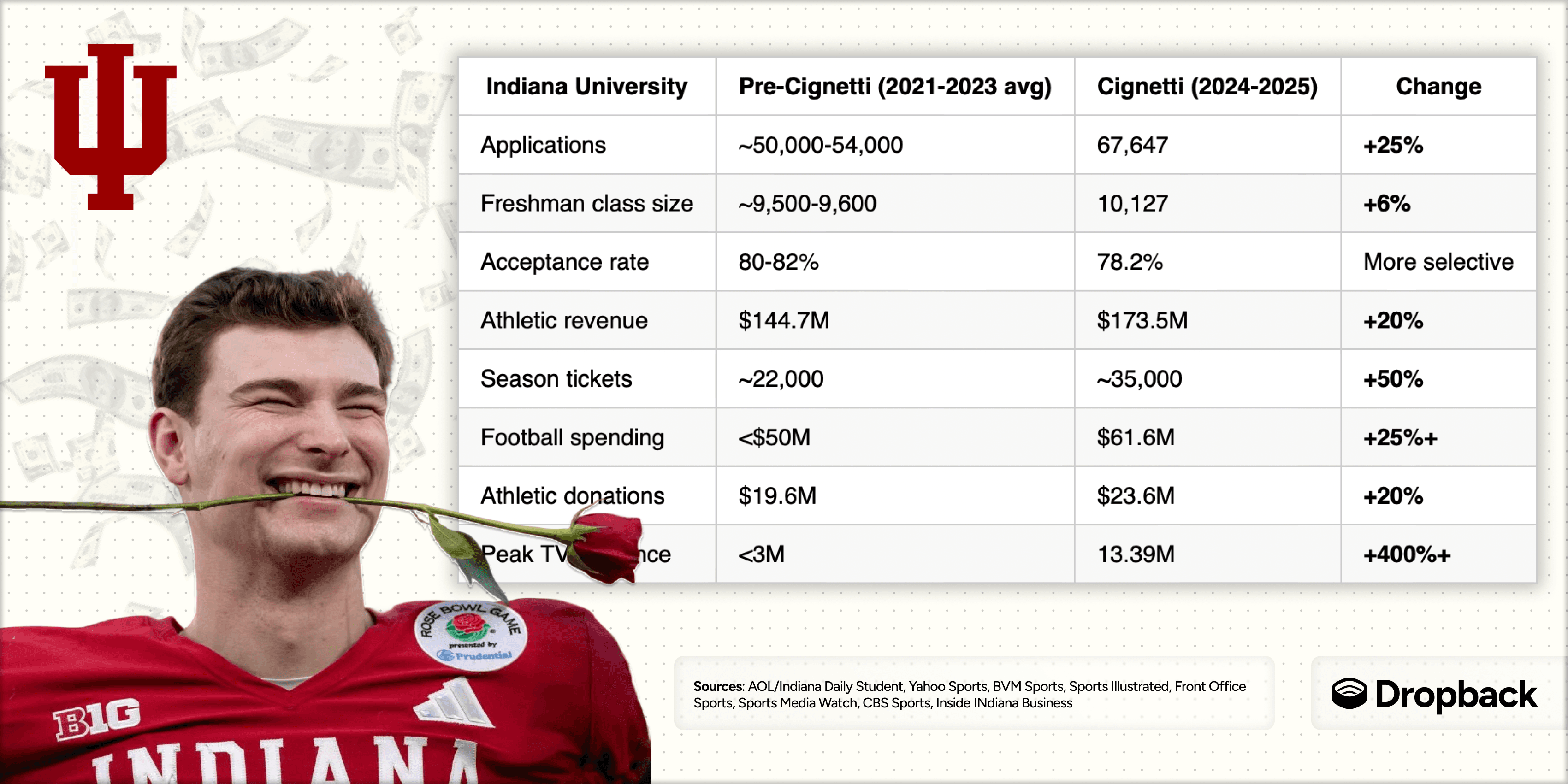
The major shift is that, the easy revenue wins are largely behind us. The low-hanging fruit was everywhere, starting with capitalizing on the most obvious asset of all: a rabid fanbase.
- Should we restructure our donor tiers?
- Should we refurbish and resell our premium seats & suites?
- Should we reseat season ticket holders?
- Should we launch new ways to interact with donors, like private events and practice access?
Donors love a return on their investment, and the solutions to these questions immediately started working: renovated suites, new club experiences. A donor writes a check and gets that short-term dopamine of a shiny, tangible outcome. Exciting!
Is The Well Drying? (seriously) (for real this time)?
The long-term effect of hammering donors? That ROI story has a shelf life.
At some point, the novelty of a new suite wears off. A donor who wrote a $3M check is going to look around from their premium seat and watch their team go 3-8. Fancy seats stop being compelling ROI when the product on the field doesn't match.
Their feedback next fiscal year? "Well, to get that winning team, we need more! $30M, $40M rosters and climbing! Chip in and donate today!" And the treadmill of creative revenue generation continues.
This was the fork in the road for administrators at NACDA.
- To keep the money coming, the Revenue Generation playbook asks: How do we get more?
- Or a new playbook — revenue integrity — asks a different question alongside it: Are we allocating what we already have in a way that actually wins?
Revenue integrity investigates, that $3M check… was it leveraged in the best way, to put the best product on the field? What do we have to measure the usage & impact of that investment?
Maybe there's still juice to squeeze on the generation side to fuel payroll (jersey patches, NIL workarounds). But embracing revenue integrity is what separates programs that sustain success from the ones who can't figure out why the well is drying up.
Revenue Integrity Will Drive Sustained Success
The dawn of Revenue Integrity explores the hard questions at the real root of the payroll problem.
Emerging Front Office of every sport — Football, to even Volleyball — are being tasked with leveraging the investment that revenue generation funds, to build the best collection of talent within budget.
But simply fueling that Front Office with more capital is, by itself, the easier lever to pull. When you can just outspend the other guy, you don't really have to evaluate talent. You don't have to think critically about allocation — you just need a bigger checkbook.
But that's not a strategy. That's an arms race. And arms races always end the same way: somebody runs out of ammo.
Winning is downstream of roster construction. And roster construction is now, for the first time, a financial exercise too — not just a scouting one.
Before revenue sharing, it was scholarships and walk-ons, infinite roster flexibility, no real financial accountability on a per-player basis.
Now? You have hard roster limits. Finite budgets. And every dollar you spend on Player A is a dollar you can't spend on Player B.
This changes everything, and the question now becomes:
- if the best way to generate donor ROI is to win…
- and the best way to win is to build a great roster…
- and the best way to build a great roster is to allocate your money wisely…
- then the single most important new capability for any athletic department heading into the next era isn't only fundraising. It's financial discipline around roster decisions.
Using the Proven Playbook: Pro Sport Front Offices
The programs that will thrive are the ones laboring over every dollar spent on a player, and optimizing the decision-making process with frameworks & strategies the entire front office believes in.
How do we know? Because pro teams have been doing it for decades.
Every NFL and NBA team employs front office staff — from salary cap managers to quantitative researchers — whose entire purpose is to make data-driven financial decisions:
- Translating on-the-field data into off-the-field value
- Powering negotiations with analytical & fiscal models
- Simulating hundreds of roster & cap scenarios
College sports is finally arriving at this same crossroads. And the programs moving fastest — the ones hiring GMs, building front office infrastructure, investing in data and process — are internalizing the lesson pro teams learned long ago:
You can win in the short-term by out-spending. You will win in the long term by out-allocating.
Here's to the Next 18 Months… and Beyond
Inventing $20.5M was hard. Doing it again at 2-3x will be harder, and the treadmill isn't stopping.
So the question for your department isn't can you raise more — you'll have to. It's whether every dollar you raise actually wins.
Out-spending buys you this season. Out-allocating builds the next decade. That's revenue integrity, and that's the era elite athletic departments are walking into.